
Where the families are: the assignments page, the Telegram channel, and what a request tells you
Every family looking for a tutor on Learn Now appears in three places — your Find Students page, the public assignments page and the Telegram channel. Here is what a request tells you, what it keeps back until the trial is paid, and how the 23 days of a request run.

A family posts a request once, and it appears in three places at the same time. Which one you read from is up to you; the request is the same, and so is the quote you send.
The three places
Find Students, in your console. Every open request for a subject and level you teach, with one thing the other two places do not have: how far it is from you — "about 25 min from you by public transport", or by car if that is how you travel, worked out from your postcode to the family's planning area. Nobody sees your postcode; the minutes are for you.
The assignments page, learnnow.com.sg/assignments. The same requests, open to anyone, laid out the way Singapore's assignment channels have always laid them out. It is where a tutor who has not joined yet sees what families are asking for, and it is the page a request's link points to.
The Telegram channel. Each new request is posted there as it arrives, with a link to the assignment. When the request closes, the post is edited to say so — ✅ Filled, or Closed — so the channel never shows you a job that has gone.
What a request tells you
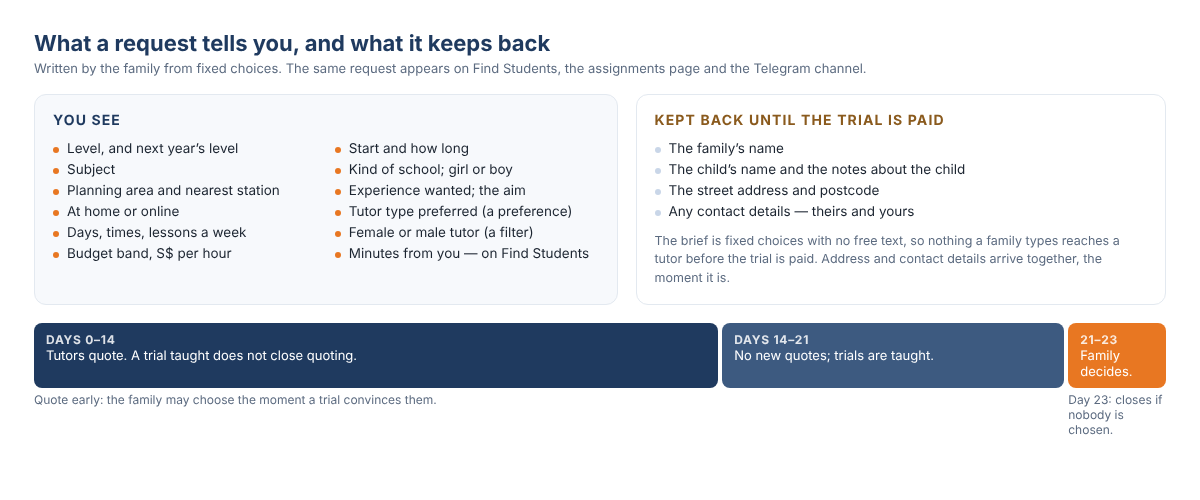
A request is written by the family from fixed choices, so what you read is what they chose, not a guess. You see the level, and from October the level next year as well ("P3, P4 in 2027"); the subject; the planning area and nearest station; whether lessons are at home or online; the days and times, and how many lessons a week; the budget band, as S$ per hour; and the brief — when they want to start, how long they expect to continue, the kind of school, whether the child is a girl or a boy, the years of experience they would like, and what the lessons are for (keeping up, catching up, exam preparation or stretching ahead).
Two preferences may appear with it. A family may say which kind of tutor they would prefer — current MOE, ex-MOE, full-time, part-time — and that is a preference, not a filter: you may still quote, and tutors of the preferred kind are simply listed first. A family may also ask for a female or a male tutor; that one is a filter, and the request says so.
What it keeps back
Until the family has paid for a trial lesson with you, you do not see the family's name, the child's name, the notes about the child, the street address, or any contact details, and the family does not see yours. The brief is fixed choices only, with no free text, for the same reason: nothing a family types reaches a tutor before the trial is paid. The address and the contact details arrive together, the moment the trial is paid.
The 23 days of a request
A request runs like a small tender, and the dates are fixed when it is posted. For 14 days tutors may quote; a trial taught on day 7 does not close quoting, and a quote on day 10 is still a quote. For the next 7 days no new quotes are taken and the trials already booked are taught. Then the family has 2 days to choose one tutor or none. If they choose before that, the request ends the moment they do. A request that nobody is chosen on closes on day 23 and every trial taught is paid on the usual trial terms.
Sending a quote
One quote per request: a price per hour and a short message, up to 500 characters, checked for contact details before it goes. The price is yours. The budget band is what the family said they expect, and you may quote above it if your qualifications and results justify it — the band is information, not a ceiling. If you change your mind, you can withdraw a quote; the family's other quotes are unaffected.
Before your first quote, two things must be in place: a profile with your subjects, levels and rates, because the family needs something to look at; and the tutor declaration, confirmed once. After that, quoting is one form.
What it costs
Learn Now's fee is the trial lesson — and only if the family picks you. If they try you and choose someone else, you are still paid half the trial fee for the lesson you taught. From lesson 2 the platform fee is at most 5% of each lesson, fixed for each lesson on the day it is paid for, and shown on your Finance page.
Two other ways families reach you
A family can save your profile and ask you for a quote directly; you are told first, and the request otherwise runs as any other. And a family you already teach can be invited in by you, with no request posted at all: lesson 1 is an ordinary lesson with the onboarding fee, not a trial, and nobody else sees it.
One page that matters: your Find Students page, which shows every open request near you. If your profile is not finished yet, it says so at the top, and finishing it takes a couple of minutes.